Rapid pressure increase · supplementary internal test · water-hammer-type approach
SUPPLEMENTARY
Severe loading to complement hydrostatic pressure holding tests.
Purpose and principle
Characterise the behaviour of a PP-R pipe subjected to a rapid pressure increase: record the maximum pressure reached and check for leakage, cracking or rupture.
Conditions / parameters
Temperature
20 °C
Loading
Rapid pressure increase · internal procedure
Data acquisition
10 pressure records
Variables studied
Maximum pressure pmax and specimen condition
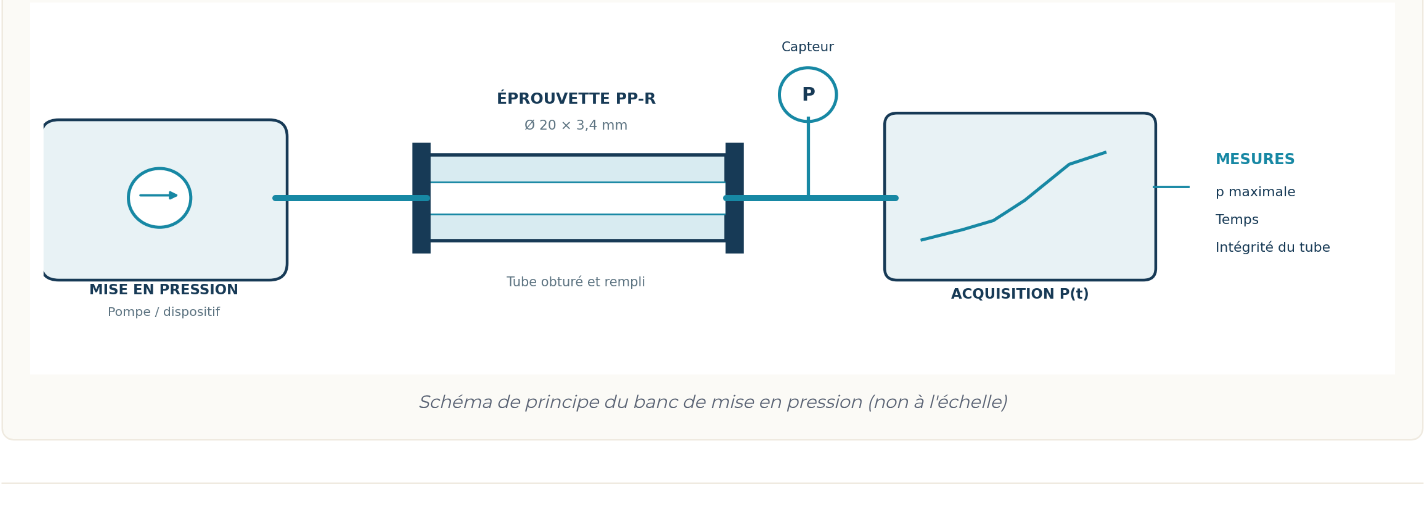
Test setup
Schematic of the pressurisation test rig (illustration, not to scale).
Test procedure
Prepare the pipe and seal both ends.
Purge air from the circuit, check the connections and initialise data acquisition.
Apply the rapid pressure increase according to the internal procedure.
Record p(t), identify the maximum pressure reached and inspect the specimen.
Expression / calculation
pmax = maximum pressure recorded during the pressure increase [bar]
Method note
If no rupture is observed, pmax represents a pressure reached, not a burst pressure. A real water hammer also depends on the change in flow rate and the propagation of pressure waves: this test does not qualify a piping network.